

In multi-domain operations, siloed data creates operational challenges and potentially imperils mission effectiveness.
In an earlier post, we laid out the three choke points that slow down the processing, exploitation, and dissemination (PED) cycle: getting data off the sensor, storing it and distributing it to analysis tools, and shortening the time from analysis to exploitation. That post made the case. This one shows the math.
Below, we follow a single airborne ISR mission from wheels down to the moment an analyst sees a signal on screen. We put minutes on every stage, show where they pile up, and then show where SensorXpress gets them back.
The Mission: One Sortie, 9 TB of RF Data
Here's our working example. The numbers are representative rather than pulled from a specific program, but they're in line with what modern airborne platforms collect. The aircraft spends four hours on station, collecting an average of 5 Gbps of radio frequency data in VITA 49 format, or roughly 9 TB in total.
Back on the ground, that data has to reach three analysis applications, each rated for 10 Gbps ingest. That's typical: most analysis tools operate in the 10 to 40 Gbps range, while battlefield sensors can push 100 Gbps or more. Getting the data off the aircraft means removable media, copied over a link that sustains about 1 GB per second.
When the aircraft lands. That’s when the clock starts.
Where the Minutes Go
1. Offload: 150 minutes
Moving 9 TB off the aircraft at 1 GB/s takes 9,000 seconds. That's two and a half hours before anyone has looked at a single sample, and it assumes the copy runs clean. A failed transfer means starting over.
2. Storage and staging: 120 minutes
Next, the data lands in enterprise storage, gets verified, and gets indexed so analysts can find it. Most storage was built for steady enterprise workloads, not multi-gigabit RF bursts, and ingest and reads fight over the same I/O path. Call it another two hours.
3. Tool ingest: 360 minutes
This is the big one. Each unique analysis tool takes 10 Gbps, or about 1.25 GB/s, so if it needs all the data, feeding it the full 9 TB takes two hours. Because all three tools pull from the same shared storage, they end up taking turns. Three tools at two hours each is six hours.
4. Re-transmission: 72 minutes
When a stream outruns a tool, the overflow is dropped or has to be sent again. It's the water-glass problem from our last post: pour too fast and it spills. If 20% of the data has to be resent, that adds 72 minutes, plus memory pressure on the tools themselves.
Total: 702 minutes. That's nearly 12 hours from wheels down to a complete first pass, and most of it is spent moving data, not analyzing it.
The Timeline, Side by Side
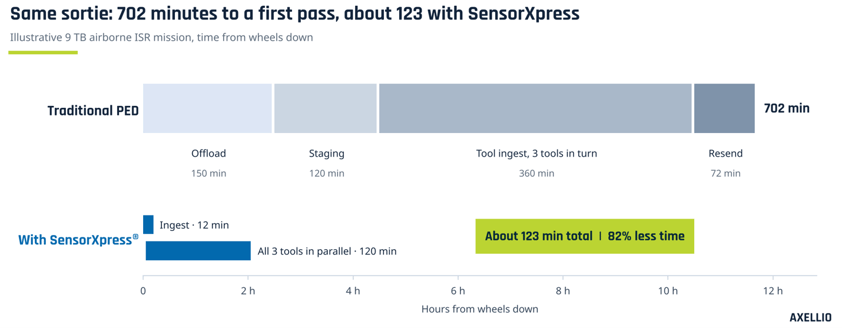
The analysis itself barely changes. What disappears is the copying, staging, queuing, and resending around it.
Where SensorXpress Gets the Time Back
SensorXpress doesn't make your analysis tools faster, it removes the waiting around them. Here's the same mission with SensorXpress at the front of the PED chain:
- Offload, 150 → 12 minutes. SensorXpress ingests any RF protocol, including raw I/Q and VITA 49, at over 100 Gbps sustained. At that rate, 9 TB comes in about 12 minutes. On platforms where SensorXpress records in flight, there's no separate offload step at all.
- Storage and staging, 120 → 0 minutes. SensorXpress writes to and reads from disk at the same time. Data is ready to stream the moment it lands, so there's no staging pass, and analysis starts while ingest is still running.
- Tool ingest, 360 → 120 minutes. Instead of taking turns, all three tools are fed at once, each at its full 10 Gbps, directly from disk. At 1.25 GB/s, each tool works through the full 9 TB in 120 minutes, and all three finish together. Load balancing can spread streams across additional tool instances to cut that further.
- Re-transmission, 72 → 0 minutes. Distribution is controlled and repeatable. Each stream is paced to what its tool can consume, so nothing spills. When an analyst wants a second look, DVR-like replay pulls the data straight from storage.
Because ingest overlaps distribution, the full pass comes in at roughly 123 minutes instead of 702. That's an 82% reduction with no change to the toolset, and spreading streams across more tool instances moves it toward the up-to-90% PED time savings we outlined in our earlier analysis.
Nearly Ten Hours Back, Every Sortie
Your numbers will vary with your sensors, links, and toolsets. The pattern won't. Most of the PED timeline is spent moving data and waiting on it, and that's exactly the part SensorXpress is built to remove. Getting nearly ten hours back after a single sortie is the difference between intelligence that shapes the next mission and a report on the last one.
SensorXpress is software-based, protocol and frequency agnostic, and runs on COTS hardware from forward-deployed platforms to rear-area C2. To see what the timeline looks like for your mission, contact the Axellio team or visit the SensorXpress page.
Frequently Asked Questions
What is the PED cycle?
PED stands for processing, exploitation, and dissemination. It's the process that turns raw ISR sensor data into actionable intelligence and gets it to the people who need it.
Where does ISR data get stuck in the PED cycle?
Most delays come from moving data, not analyzing it: offloading it from the sensor, staging it in storage, feeding it to analysis tools that ingest slower than sensors collect, and resending data that overflowed those tools.
How much can SensorXpress reduce PED processing time?
Depending on the mission, SensorXpress can reduce PED processing time by up to 90%. In the example above, a full first pass dropped from 702 minutes to about 123.
What RF data formats does SensorXpress support?
SensorXpress is frequency, protocol, and hardware agnostic. It ingests RF data from any sensor, including raw I/Q and VITA 49.
Can SensorXpress feed multiple analysis tools at once?
Yes. It distributes data to multiple analysis applications simultaneously, in real time or on demand, with each stream paced to the rate that tool can handle.
Is SensorXpress suited to airborne and tactical platforms?
Yes. It ingests, stores, and distributes 200 Gbps in 1RU with low SWaP, so it fits airborne and forward-deployed platforms as well as ground stations and data centers.